
It's Carrick, you know...
...and it might be hard to believe, but maybe it does matter for the coach to have some understanding of Manchester United

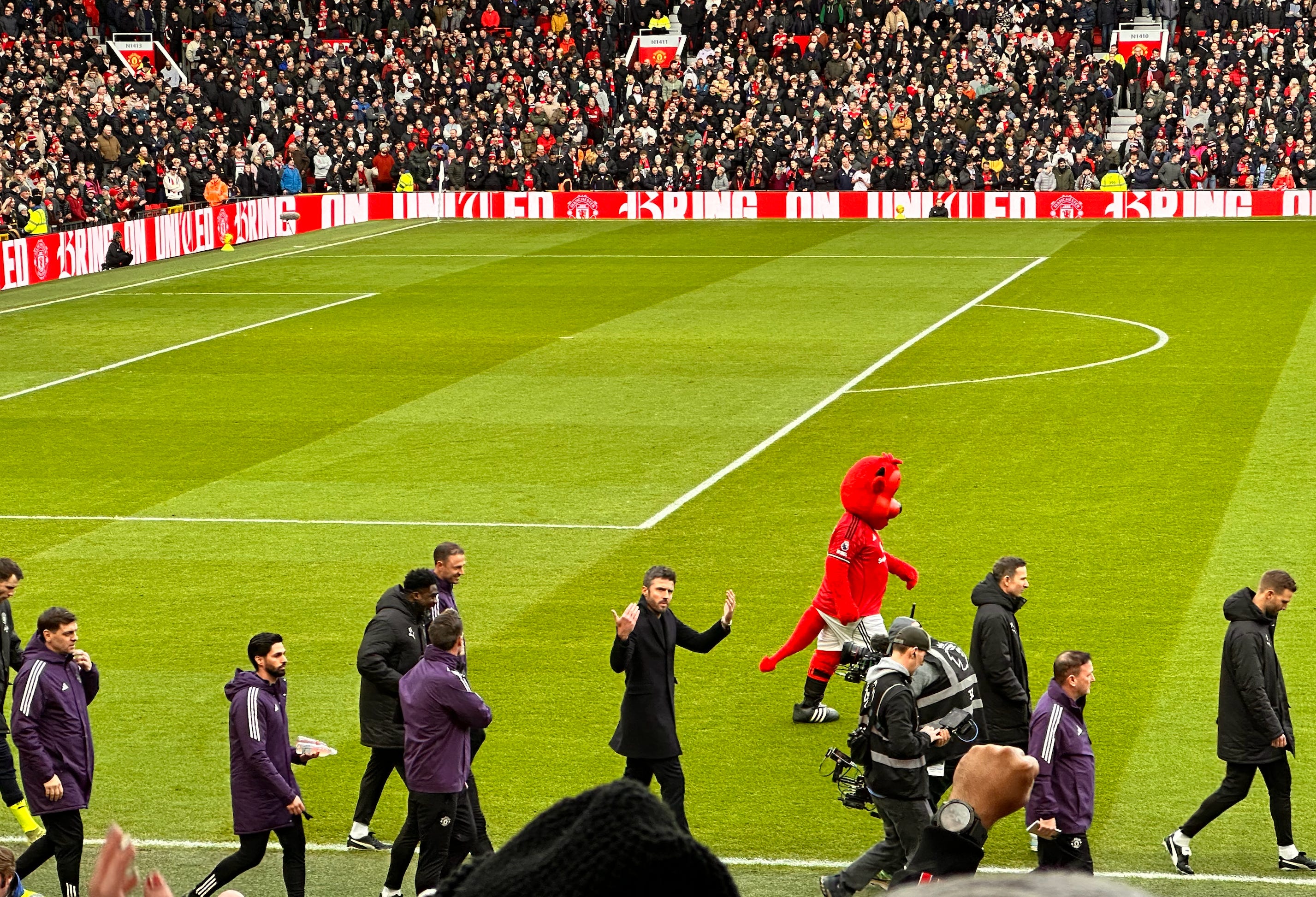
Before the Manchester derby, Sky Sports took great delight in exploiting the Roy Keane machine by posting more negativity on their social media feeds. Keane refused to back down over comments made about Sir Alex Ferguson hanging around ‘like a bad smell’, Michael Carrick’s relatives ‘picking the team’ or the question of why Jonny Evans deserves a place on the coaching staff.
We were all reminded of Gary Neville’s comments that Carrick should not get the job of Manchester United on a permanent basis. Neville is an opportunist - and this is a comment made in full praise - and maximises the most of every opportunity that comes his way. That’s how he made a magnificent career. It’s how he became a property mogul in Manchester. It’s how and why he leans into being a political figure. It’s also how he made the transition from player to pundit, seamlessly, and how in recent years he has become their figurehead of podcasts and fan media.
So the narrative was established before kick-off, and the knives were drawn with predictable topics.
Manchester United were derided just as much as Michael Carrick was. So they were going to another interim manager again, who happened to be a former player. Why would they do such a thing - it was doomed to failure. You must follow the data today. Ole Gunnar Solskjaer’s last few results - good grief, why don’t you just look at them if you don’t believe us?
But Solskjaer’s tenure saw the greatest connection between the club and the support in the post-Sir Alex era. The last home match before the COVID lockdown was a 2-0 win over Manchester City - fully deserved, sealed by a last minute Scott McTominay goal from long range. The first two home matches after the lockdown, against Leeds and Newcastle, saw similarly electric atmospheres.
You can add January 17th, 2026 to that list now, as United thoroughly deserved their 2-0 win over a Manchester City team that hardly had to be contained in the same way of Guardiola teams of old. United were not just good - they were dominant, good value, and probably good value for a scoreline that was double.
Three goals were disallowed, two efforts hit the woodwork, and Carrick read the pulse of the game so magnificently that, as he stood on the touchline with the seconds counting down to full-time, it was impossible to escape the thought that the fact that his connection to the club played a large part in what transpired.
Such has been United’s inconsistency, City’s certainty, and the supporters’ relative comfort with this as the status quo, that there was almost an air of resignation to a heavy defeat before the match, in much the same way as Sky Sports appeared to be gleefully predicting. So when City were making so many uncharacteristic errors early on, you couldn’t help but wonder if they were being so poor as to lull United in. And, when United entered the break with nothing but two disallowed goals to show for it, one would not have been blamed for feeling they had missed their chance.
Carrick’s trick had been to play both Amad and Mbeumo from the start, with the latter playing through the middle, and it was this approach which was the key to winning the match. When the decisive goal arrived, Mbeumo finishing from a Fernandes assist, the route in which it was delivered was as inevitable as the goal itself.
The United head coach, or interim, or manager, was brave enough to bring off Mbeumo for Cunha, and that change worked wonders - it was Cunha’s dribbling ability which created a second, for Dorgu, and if not for a flag would also have created a third for Mount.
One cannot discount the simplicity of horses for courses, or square pegs in square holes - Mainoo alongside Casemiro, with Bruno Fernandes in front, has always seemed like the correct way to balance this midfield combination. All three were the heartbeat of this magnificent, breathless display, and apart from a few shaky moments, it was a fine defensive display from Dalot, Maguire, Martinez and Shaw.
In front of them was a tired City pastiche; pass, pass, pass, orbit the penalty area, try and find an incisive run to pull back across goal. And, as the years went by and the regulations allowed City to take the flavour of the months from the overachieving teams, stockpiling their squad with an intention to farm that same player out three years later, there appeared to be little anybody could do on the pitch to defend it either.
The greatest coaches adapt to change, though, and City under Guardiola have always been vulnerable in the same areas. The problem has been that they have always had the better footballers, they have signed in-form players, and their turnover of mistakes has been ruthless and unforgiving.
Ole Gunnar Solskjaer found a way to play against it. So did Erik Ten Hag. So too did Ruben Amorim. United had to be compact and disciplined but found constant joy on the counter, to which City had no response and no reaction.
Afterwards, Carrick admitted it was as close to a perfect day as he could have envisaged, while stressing it was only one day.
And it is only one, but it’s one which serves as a shot of evidence of the undefinable, the incalculable, the things that are left open to derisory mocking. Carrick shied away from a question about it being the DNA of the club, but there is some correlation between someone who understands the basic fundamentals, and a performance which ticks all the boxes, just as it did in the Solskjaer era. United played on the counter, they played with aggression, tenacity, and no little skill or individualism. They had a game plan which included a license of expression.
One ought not to discount the performance in the FA Cup Final, as Ten Hag set United up perfectly, and they ought to have been three goals up at half-time in that one, too, but on sheer performance alone, this was the outstanding display that stood above any other since the Solskjaer era.
It would be ridiculous to use the evidence of one game to construct a narrative about the prospect of United’s identity being more easily identified by a coach who has been a former player, but one game is the start of evidence to add to the Solskjaer reign; and if it continues to provide good results, even if those results are not perfect, then there is the weight of an argument too strong to be dismissed out of hand.
Solskjaer had done good things at Molde but this was not an overwhelming CV to make someone favourite to manage Manchester United. Michael Carrick had a good but not completely inspiring record at Middlesbrough. But they both understand Manchester United, a job that has proven to be too big for some of the most experienced, most successful, Premier League proven or up-and-coming European elite coach… none of whom ever did appear to understand what it meant to manage United, and so, can we summarily dismiss this quality when it seems to be fundamental?
Can we truly disregard the calm, the respect for the history of the club, the experience of what it takes to be surrounded by the noise, shut it out and achieve? There must be an inherent value, difficult as it may be to articulate, something which equates to another attribute. Is it of equal or greater value to understand the background of Manchester United and the sensationalist nature of the press, as it is to win the top league in the Netherlands or Portugal?
At the very least, it appears as though the jury can be out. We will learn about Carrick, and we’ll learn if there’s something more significant or substantial to invest in the idea that to know the workings of Old Trafford, to truly understand the pressure of the club, is of equal or greater value than another attribute.
Perhaps one game is enough evidence for all the mocking to be put on hold, though. Especially from those who know the pressures of the club more than any other.
To be at Old Trafford and feel the emotional energy - not withstanding the fact it was a derby match - was to understand that there is something greater than data and analytics and spending billions of pounds to either watch your team pin another team in the penalty box or be pinned in the box by another team. A United data analyst was appealing for people to apply to join the team this week - and a click through to the job application reminded us all that Manchester United are ‘transforming into a fully data-driven organisation’. Today was the antidote to that. The future of the game depends on the resistance of this migration and the acceptance that there is room for everything. The beauty of football is the incalcuable.
There has to be some form of joy great enough to conjure happiness from weary bones on a cold winter’s day in a miserable season which started with long-time season holders being shunted into new seats. That joy comes through winning a game of football but also from the connection of what you know and understand and love, and the reason why you support in the first place… and not because you were told to, not because someone dictated this is the way it will be now. But because it just is, and just feels right.
Michael Carrick might not be the right man for the job; it might all go horribly wrong after this. But he is more right for it than Ruben Amorim ever was. And the reason for that is something greater than the comparison between Carrick and Amorim.
It’s the history of Manchester United and what it stands for.
And what a relief to know that that feeling still exists.
At the very least, there appears to be genuine hope that United supporters can look forward to their few remaining visits to Old Trafford this season with the idea they might see some attacking and entertaining football, which is more than could be regularly said for four years. They can look forward with hope of European football, or even Champions League football, next season.
And if they achieve that, then who’s to say that Michael Carrick won’t be the best man for the job after all… and who’s to say that a large reason for that won’t be precisely because he knows the club?
Spot on Wayne
Brilliant piece Wayne. As you say it's such a relief these special days can still happen. I remember Brian Hughes saying after the three nil against Bilbao that no amount of drugs could supercede the feeling that night. That's how I've felt all day.The rest of the season is now the bigger test but by god what a start