
Risky Business

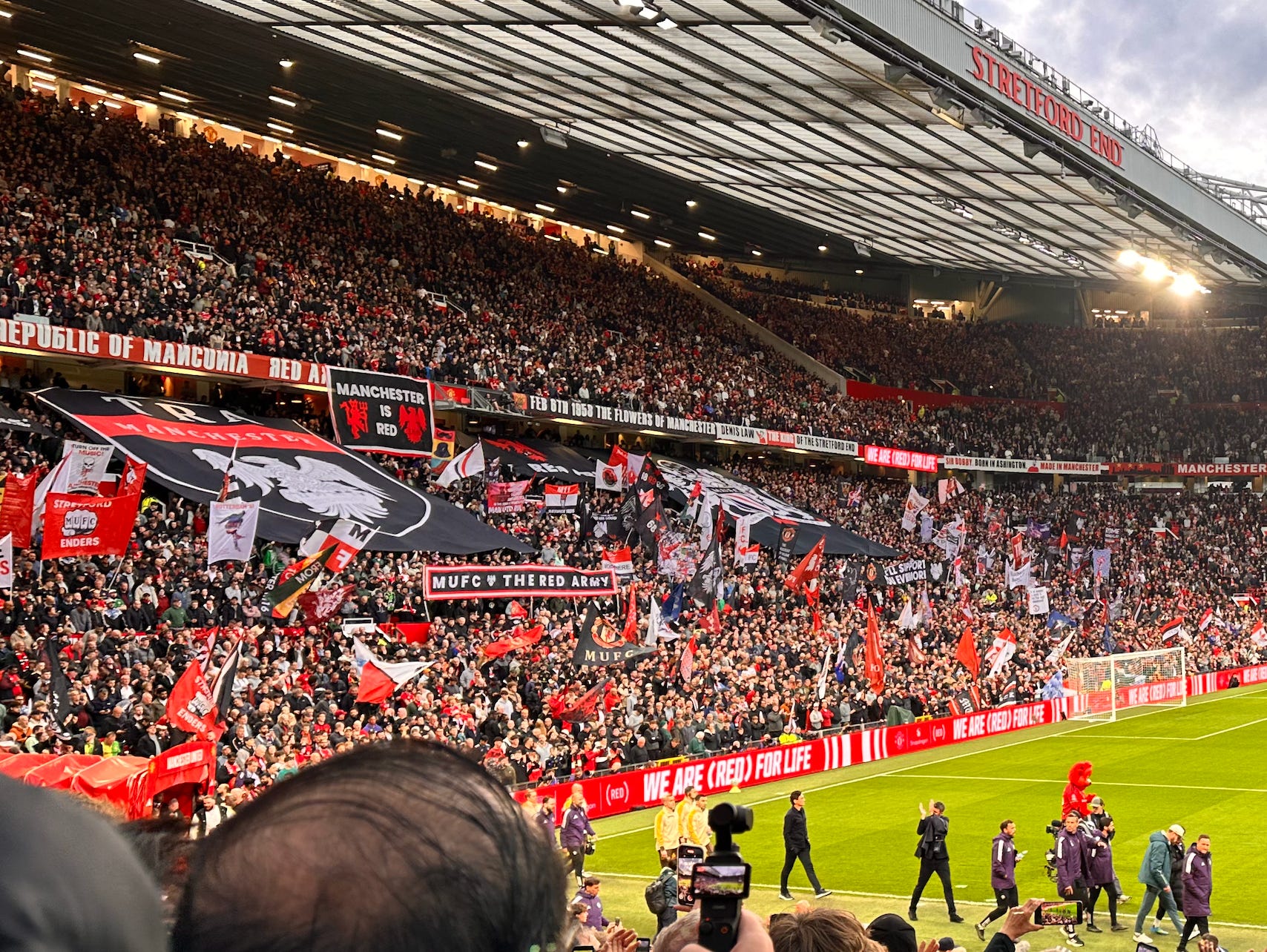
Three years ago today, the statue of Jimmy Murphy was finally unveiled at the Stretford end, following years of campaigning and a concerted push by a fan coalition.
I wasn’t part of the coalition, but my biography of Jimmy provided a vehicle for the private pressure on the club to become public when the journalist Steve Yates used it and letters from the Association of the Former Manchester United Players to generate some momentum.
The statue for Jimmy would be well deserved if only in recognition of his dedication to the club and his work in developing young players like Duncan Edwards and Bobby Charlton; but of course, as we all know, it was what he did on the days, weeks and months after the Munich air disaster, not only keeping the club alive, but keeping them competitive, which is the biggest reason why the recognition was so necessary.
On this day in 1958, United reached the FA Cup Final, and though they were beaten, it was an achievement to have got there at all.
That was unthinkable considering the strength of the club prior to the crash, which was the strongest it has ever been in history. Stronger than at any point in the 1990s or 2000s. United were poised to clean up domestically and would almost certainly have been the side to take Real Madrid’s place as the supreme team in Europe. After 1958, it took another five years for Matt Busby to build a side that could win trophies again. It’s hard to build a great team - harder to build one that sustains success - harder still to rebuild one to get there again.
As modern Manchester United fans know all too well.
The changing face of football has made Champions League qualification a necessary achievement to celebrate, and the days when it used to be celebrated as ‘just like a trophy’ which were mocked now have a depressing truth anchored to them, because of the tens of millions a club receives for merely competing, and the difference it can make when you don’t have those tens of millions, as United have found out all too often in the last decade.
The standard of the league this season has been so poor that when May began, United still had an opportunity (strictly mathematically, at least) to win the title. It is the same sort of arithmetic that stands between them and qualification for the Champions League next season. That was the objective at the start of the season, and, when United contrived to draw games at Forest and Spurs and at home to West Ham, there was still even a momentary contemplation that the club may have been on top of the table if those results had been wins. Still. It never even felt, at their best, that this team were genuinely going to get into Europe.
Whether or not the squad felt undermined by Ruben Amorim’s public castration of the team’s ability or his ultimately catastrophic inability to play the best players in their best positions, never before in the post-Ferguson wilderness has it been so evident that within the myriad of issues that impact the club, changing the manager would have such a clear benefit.
I still could not bring myself to campaign to sack the manager, not because I’m a better fan than anyone, but because we’d already seen so much change. In other times, we’ve seen decent arguments for all of the successors to have been given more time than they had, except maybe for Erik Ten Hag.
When Sir Jim Ratcliffe relieved Ruben Amorim of his duties, the objective of the club with the appointment of Michael Carrick was to finish as high up the table as possible. The intention was clear - stability, with a view to four or five months looking for a permanent successor.
Ratcliffe and his management team had, in appointing Amorim, attempted to install a new ‘United way’, before discovering that the tradition of the club is there to be respected as a custodian and can not simply be reinvented, unless your name is Matt Busby or Jimmy Murphy. It was not their intention in hiring Carrick to bring back familiarity to the support - in fact, it appears that Ole Gunnar Solskjaer’s application was probably rejected with that thought in mind.
But that’s exactly what has happened, and Carrick’s calmness has been one of the most influential factors to the club stabilising and the team starting to feel like itself. It has been a four month spell to redefine perspectives of the Solskjaer era too. I can’t imagine his most vocal critics are quite as eager to concede the point, but those derisive comments about him being a PE teacher and such a disaster have felt a little hollow in the forthcoming years, as United have won trophies and even qualified for the Champions League, but never felt stable. They feel even more hollow now, as that same blueprint has been followed.
In the Amorim era in particular, if the style of play wasn’t poor enough, we were subjected to a weekly soap opera in the press. The manager had come in to the job insisting facing the cameras was a new thing and wouldn’t be a common thing, but it was, and it was somewhat appropriate to the era that he was ultimately dismissed for a performance in a press conference rather than a result on the pitch.
United supporters were furious to be in this position again, especially under new football leadership which had promised to rectify the errors of the past, when multiple of their managers had been dismissed mid-season. Carrick’s appointment, let us be in no doubt, was the frugal option and reflective of the fact that there was no money in the moment and no long-term alternative plan in place.
That lack of plan has, ironically, been to the major benefit of Manchester United. Carrick has removed the hysteria, given the squad a confidence boost, and played a functional system to get the best of his players.
Over a full season, Carrick’s form is title-winning form, though even Paddy Crerand and Wilf McGuinness might concede this would be the weakest United team to have ever been in such a position, as they found themselves this weekend, as the team who went as many ‘gameweeks’ (ugh) as any other in the post-Fergie era before finally being out of the title race. No, there will be no clamour within the Old Trafford support to start suddenly proclaiming these players the best of all time as we have seen in the red corners of Merseyside and North London - but neither are they the worst, now that they have been able to thrive in a formation that doesn’t bring the worst out of them.
It would be nice if United made certain of qualification for the Champions League with a win over Liverpool and it would be the strongest case for Michael Carrick if he could do that on the way to finishing in third place. There is still the potential for a slip up or two, or an underwhelming conclusion to the season in spite of the tremendous success Carrick has enjoyed in getting to this position in the first place.
We return to the theme of timing and change. Was Louis van Gaal’s era, boring as it was, a foundation he could have built something greater on? Would it have been wiser to back Jose Mourinho’s judgement rather than Ed Woodward’s, in the summer of 2018 where Mourinho threw his toys out of the pram? If a £30m package could be found to sign Cristiano Ronaldo in the summer of 2021, why wasn’t the same money available for Solskjaer to sign the midfielder the squad sorely needed?
The managers all paid the price for these moments, and that’s football, I suppose. But Carrick’s unexpected success has put Ratcliffe and his team in a very difficult position - one without an obvious answer, again. After all, it is equally sensible to say it is a risk to take Carrick away from the job considering how well he is doing, and a risk to leave him in post considering his inexperience.
It is the first time in the post-Ferguson era that the powers that be find themselves in a summer where they have overachieved based on expectations when they made their last change, and still are placed in a scenario where they have to make a decision on a manager.
Carrick’s case has been strengthened not only by United’s form but by the pattern of events which have concerned possible contenders for the job. Thomas Tuchel committed himself to England beyond the World Cup, and Carlo Ancelotti did likewise with the Brazil national team. Roberto De Zerbi was sacked by Marseille and hired by Spurs after trying to pitch himself for the United job recently. Luis Enrique appears to have insisted his future remains in Paris. Oliver Glasner seemed a viable option because of his success with a three at the back, but that seems like another time now, and Glasner’s stock at Palace has tumbled. Marco Silva is a name who always appears on these lists but United really would be gambling if they went there.
Who is left? Well, Julian Nagelsmann, former coach of Hoffenheim, RB Leipzig and Bayern Munich, and current coach of Germany and he’s still younger than Ruben Amorim, as he turns 39 this summer. It must be some concern that one of the reasons he left Bayern was because of reported difficult relationships with the players, which brings Amorim and his age immediately to mind.
Gareth Southgate, a favourite of Ratcliffe, will always hang like a spectre - that factor making him feel like an inevitability for the job at some point. Confronted with the alternatives, those erstwhile criticisms - that Solskjaer, then Carrick, got their chance purely because of their connection to the club - whilst true start to feel less like negative points and more like elements which count tremendously in their favour.
A common failing of every manager other than those two has been a manager’s failure to grasp the size of United, their failure to understand what it takes to control the club, and in that regard, it possibly makes Carrick’s experience just as valuable if not more, than any success Ten Hag or Amorim had in their respective homelands before making the move to Manchester.
The thing about football is that every single decision is a risk. As supporters we place faith in the leadership team being wise enough that these are decisions which are educated risks, but there is no evidence that can give us complete confidence. That’s fine - it’s just a consequence of what happens in football. But it does place them and United in a precarious position this summer.
What Carrick has achieved is not to be taken for granted. We have seen, in the absence of it, how significant it is to have stability and understanding of the club. We have seen, through the pattern of 13 years, how difficult it is for managers to achieve consistency with a squad of players that was put together through three or four different managers.
The results are the results, though, and as we are often reminded by those who have used Mikel Arteta’s reign as a point of reference - league performance is a stronger indicator of a team’s progression than a cup success. Fair enough. United have finished in second place twice since 2013, never really threatening for the title, and this season is as late in the day as they’ve ever been ruled out of the race in that team, despite again never realistically challenging.
It is still as far as United have come in the meantime and has taken them five years to get back to as good as it ever got under Solskjaer; and this, make no mistake, is by accident and not design.
The primary thing that proves, beyond any justified criticism of the standard of the league, is how difficult it is to rebuild - a lesson this club knows, be it after Munich, be it after the 1968 European Cup and the Busby retirement, be it the sacking of Tommy Docherty, be it the retirement of Sir Alex, or any of the sackings in the recent years.
It seems like the least risky thing to do would be to back the man who has overachieved to get United in to this position with what he has inherited. Especially if he ends the season strongly.
I really hope we keep Carrick, I can’t face another ideologue coming in and the circus that will come with them. The squad still needs serious work just to play all the extra games we’ll have next year, managerial stability, with a manager that understands the club, is really the best option.